

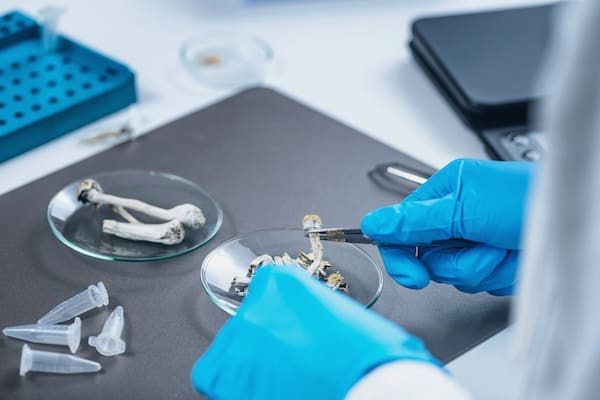


For New York patients living with treatment-resistant Depression (TRD), new therapies can feel like rays of hope breaking through the darkness. The highly publicized clinical trial of psilocybin in the New England Journal of Medicine (Goodwin et al., 2022), captured international headlines by suggesting that psychedelic therapy could significantly reduce depressive symptoms in some patients, drumming up significant interest around available psilocybin therapy NYC options.
As with any experimental therapy, the details of psilocybin as a treatment for Depression do ultimately require a bit more scrutiny. A closer look at the NEJM trial reveals serious challenges: psilocybin treatment is intensely labor-intensive, requires two therapists to remain with the patient for many hours, and produced traumatic psychological reactions—so-called “bad trips”—in roughly 25% of patients.
In this article, we’ll take a deep dive into the psilocybin trial results, explain the risks and limitations of psychedelic therapy, and discuss why TMS and Spravato remain safer, more reliable, and more accessible treatments for TRD today.
The NEJM Psilocybin Trial: Hype vs. Reality of Psilocybin as a Treatment for Depression
The 2022 landmark trial on psychedelic therapy published in the New England Journal of Medicine led by Goodwin et al., was—and remains—one of the largest modern randomized studies of psilocybin for Depression. Below are a few of its methodologies and findings:
- Design: 233 adults with treatment-resistant Depression were randomly assigned to receive a single dose of psilocybin (25 mg, 10 mg, or 1 mg as control).
- Therapist support: Each session required two trained therapists present for the entire dosing experience, which typically lasted 6–8 hours.
- Primary outcome: At 3 weeks, the 25 mg psilocybin group showed greater reductions in Depression scores (measured by MADRS) compared with the 1 mg group.
- Durability: The benefit waned over time—by 12 weeks, differences between groups were less pronounced.
While the results suggest short-term antidepressant benefit of psilocybin, the trial also revealed significant safety and feasibility concerns when producing its results.
The Hidden Drawbacks and Costs to Psilocybin Therapy NYC
Though psilocybin as a treatment for Depression offers a lot of promise for certain patients, this therapeutic modality (as it stands today) does pose certain hidden costs and drawbacks. A few of the main challenges with psilocybin therapy NYC options are as follows:
Psilocybin Therapy is Incredibly Labor Intensive
Unlike standard medications, psilocybin is not something a patient can take and then return to normal daily activities. The NEJM trial required:
- Two therapists in the room throughout the dosing session.
- 6–8 hours of continuous monitoring for each patient.
- Structured “preparation” and “integration” sessions before and after the psychedelic experience.
This means that every single psilocybin session consumes two clinicians’ full working day—resources that could otherwise support dozens of patients through established treatments like TMS or Spravato. From a practical standpoint, this level of labor intensity makes psilocybin therapy extremely difficult to scale outside of specialized research environments.
The Psychological Risks of Psilocybin Therapy: 25% of Patients Had “Bad Trips”
Perhaps the most striking finding from the NEJM study was the rate of adverse psychological events. Roughly one in four participants experienced moderate to severe adverse events in the 25 mg psilocybin group. These included hallucinations, severe anxiety, paranoia, confusion, and panic—commonly referred to as “bad trips.” For some patients, these experiences were traumatic and persisted well beyond the dosing session.
While some advocates frame these episodes as “challenging but meaningful,” the reality is that many patients find them frightening and destabilizing. For people exploring psilocybin therapy NYC options who are already suffering from severe Depression, this kind of emotional turbulence can worsen distress or discourage continuation of care. Taking that risk into account, other options like TMS and Spravato are designed to minimize psychological disruption. Side effects are mild, predictable, and transient—not traumatic.
Insurance and Accessibility: Another Major Divide
In 2026, psilocybin as a treatment for Depression is not yet FDA-approved. It is also not covered by insurance, and moreover, for the time being, its use is limited to clinical trials or special research centers. This means patients would have to pay entirely out-of-pocket, often at very high costs, for an unapproved therapy that requires extensive staffing.
By contrast, TMS is FDA-cleared and covered by most major insurers for TRD. Similarly, Spravato is FDA-approved, administered in certified clinics, and insurance-covered when criteria are met; notably, Spravato was recently approved as a monotherapy for TRD patients. These benefits make both TMS and Spravato more realistic and accessible options for patients across the country.
Durability of Psilocybin Therapy NYC: Do Benefits Last?
The NEJM study also raised important questions about durability regarding psilocybin as a treatment for Depression. At 3 weeks, psilocybin showed a significant benefit over placebo but at the 12-week market, the difference between groups had largely disappeared.
This suggests psilocybin may deliver a short-term antidepressant effect—but without clear evidence of sustained remission, patients may be left chasing repeated high-dose psychedelic sessions, each with its own risks and burdens.
By contrast, TMS has well-documented long-term efficacy, with many patients experiencing remission that lasts months to years, especially with maintenance sessions in between. Spravato, when administered on an ongoing schedule, has similarly demonstrated sustained benefit in large trials.
Why TMS and Spravato Are Safer, Proven, and Practical
At Mid City TMS, we believe in evidence-based, accessible, and safe treatments for TRD. That’s why we emphasize the differences between psilocybin and Transcranial Magnetic Stimulation (TMS) alongside psilocybin vs esketamine Spravato (esketamine nasal spray)—two options that are FDA-approved, insurance-covered, and far more practical in real-world clinical settings.
Psilocybin vs TMS: Gentle, Non-Invasive, and Durable
- Stimulates brain regions involved in mood regulation without drugs or anesthesia.
- Minimal side effects (scalp discomfort, headache).
- Strong evidence base with thousands of patients in clinical trials.
- Covered by insurance for TRD.
Psilocybin vs Esketamine: Rapid-Acting and Structured
- FDA-approved esketamine nasal spray, related to ketamine but more controlled.
- Administered under supervision with standardized dosing.
- Side effects are short-lived and mild-to-moderate (dissociation, nausea, dizziness).
- Insurance-covered and integrated into routine psychiatric practice.
Both therapies are practical, sustainable, and accessible—qualities psilocybin therapy, at least for now, cannot fully claim.
Comparing Psilocybin vs Esketamine and TMS
Below is a more comprehensive breakdown and comparison of these three treatment modalities, including psilocybin as a treatment for Depression, psilocybin vs esketamine, and psilocybin as it compares to TMS. Take the following into consideration when choosing between treatment options:
| Feature | Psilocybin (per NEJM trial) | Spravato (Esketamine Nasal Spray) | TMS (Transcranial Magnetic Stimulation) |
| FDA Approval | ❌ Not approved for Depression | ✅ FDA-approved for TRD | ✅ FDA-cleared for TRD |
| Therapist Requirements | 2 therapists, 6–8 hrs/session | 1 staff monitor, ~2 hrs | 1 technician, ~20–40 min |
| Rate of “Bad Trips”/Trauma | ~25% moderate/severe events | Rare; dissociation mild/moderate | None |
| Side Effects | Hallucinations, paranoia, panic | Nausea, dizziness, mild dissociation | Scalp discomfort, mild headache |
| Insurance Coverage | ❌ Not covered | ✅ Covered | ✅ Covered |
| Durability of Effect | Benefits fade by 12 weeks | Sustained with maintenance | Sustained with or without maintenance |
Discovering the Right Path Forward with Mid City TMS
For those researching psilocybin therapy NYC options, the excitement surrounding new treatments can sometimes overshadow what actually works for patients in their daily lives. While the NEJM psilocybin trial demonstrates that psychedelic therapy may reduce depressive symptoms, the results also reveal significant drawbacks: labor-intensive sessions requiring two therapists, psychological risks including traumatic experiences for up to 25% of participants, benefits that faded within weeks, and no insurance coverage. For patients seeking lasting relief from treatment-resistant Depression, these limitations present real barriers to care.
At Mid City TMS, we focus on treatments that have been proven effective in large-scale clinical trials and approved by the FDA, weighing psilocybin vs esketamine and TMS. Both TMS and Spravato offer safer, more predictable outcomes than psilocybin as a treatment for Depression while remaining accessible through most insurance plans. Our team provides personalized evaluations, explains your options clearly, and creates long-term plans that support durable recovery—whether through maintenance TMS, continuation Spravato, or integration with medication and therapy.
If you or someone you care about is struggling with treatment-resistant Depression, we are here to help you find a path forward. Our experienced team offers compassionate, evidence-based care in a comfortable environment, and we work with you to navigate insurance coverage so that effective treatment remains within reach. Contact us today to schedule a consultation and learn how Mid City TMS can support your mental health journey—beyond psychedelics and their risks.
Sources
- Goodwin GM, Aaronson ST, Alvarez O, et al. Single-Dose Psilocybin for a Treatment-Resistant Episode of Major Depression. N Engl J Med. 2022;387:1637–1648. doi:10.1056/NEJMoa2206443.
- Ouyang W, Liang C, Cui Y, et al. Efficacy and safety of esketamine nasal spray for treatment-resistant depression: a systematic review and meta-analysis. Transl Psychiatry. 2022.
- O’Reardon JP, et al. Efficacy and safety of transcranial magnetic stimulation in the acute treatment of major depression: a multisite randomized controlled trial. Biol Psychiatry. 2007;62(11):1208–1216.